
 I’m taking a small risk by writing this post because for many years as an objective wildfire risk consultant I have stood by the standards set forth by IBHS, NFPA, Fire Adapted Communities.org and other reputable organizations. I will always stand by those standards as “Plan A”, even though those entities miss some very important principles.
People are already thinking: “uh-oh, this guy has sipped the cool aide.” Nope. “I talked to him years ago about alternative technologies, but he said they were not a magic bullet.” They are not. But augmentation to standard mitigation represents extra tools in the toolkit. I’m talking SITE SPECIFICITY here.
There are many times when a commercial or residential property owner will NOT take the proper mitigation measures…the historic home, the winery, a hand built inherited home, or traditional aesthetic rules the day. Yes, we know the right things to do: Class A roof, 0-5 foot zone, ember resistant vents and the like. Maybe they’re self-insured, maybe they’re in denial or have been misinformed.
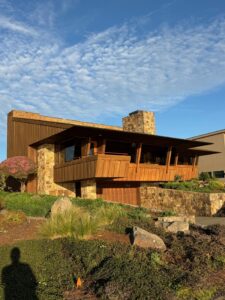
In a large event, the home pictured here would be quickly triaged by firefighters as dubious to save. So how can it be self-defended? With no guarantees, risk reduction can still occur. I’ve looked at numerous vintage or historic homes with original single pane glass, wavy with distortion over the decades, built in the 1920s…do you think people want to replace those with double pane tempered windows, and will the local historical society approve them? Probably not without loosing their historical designation. A conundrum I often face. This is the reality on the ground, working with an owner…what can be done to dramatically reduce risk, but not eliminate it?
I’ve always been very skeptical about sprinklers because water can be very effective only with the right timing and application. Otherwise, it can be a waste of time, money, resources, and is focused on the wrong priorities.
Prodigy Wildfire Solutions has an expertly engineered sprinkler system birthed from the travails of the Australian bushfires and Canadian firestorms. But for me, it doesn’t start with the product, it starts with the people which make, install, and educate others about the product. CEO George Harris is a unique chap, has a lot of integrity and intelligence, and listened to me intently as I shared my skepticism. He truly wanted to learn from me and displayed an open mind and an eagerness to change his mind! Imagine that. As we built mutual respect and rapport, I naturally developed more appreciation for the product, and I learned how well engineered it was, how it is deployed, its stellar on-site OPTEC Detection Cameras, how it could be designed to be completely off grid, and how Prodigy is launching a new FREE wildfire preparedness app.
Beyond telling you where the wildfire is, the app provides expert guidance on what to do before, during, and after an evacuation. So communication, responsiveness, professionalism, and rapport develop confidence in order to sell products. But the products must work well. Soft skills are the gateway to good products. Otherwise, I would’ve walked away.
When the Prodigy’s OPTEC cameras sense fire or smoke, they automatically deploy systematized triggering of water, covering all surfaces of this home. Additionally, applying the third-party tested Class A flame retardant Dek Gard stain to this home would keep its aesthetic appeal, but reduce ignition. An extensively tested Class A flame retardant paint developed by Fire Free Coatings, with their TRULY weather tested topcoat would change the home’s look, but be even better than Del Gard. Fire Free Coatings is the company that helped patent the Vent by coating its honeycomb structure with its proprietary intumescent paint.
FireFoil is another product which people have been critical of…yes, it is very challenging to quickly wrap an entire home, but with pre-staged segments that are labeled and ready to staple up over single pane windows in a structure structure ignition scenario, would also be a game changer.
QPL tested, ecologically, safe and plant-based Komodo could be applied to the vegetation as a Plan B option to poor D Space decisions. And those 1920s single pane glass windows that can easily break during an earthquake? 3M safety film can be applied to reduce breakage, which reduces home ignition and lacerations.
So you see, we have to think out of the box when we’re working in a very site specific manner.